Justification and Sanctification: Understanding God’s Finished Work and Ongoing Transformation
Introduction
One of the most important distinctions every believer must understand is the difference between justification and sanctification. Confusing these two doctrines leads either to legalism (trying to earn salvation) or license (believing growth does not matter).
👉 Scripture teaches both clearly: justification is God’s instantaneous declaration, while sanctification is God’s ongoing work in the believer.
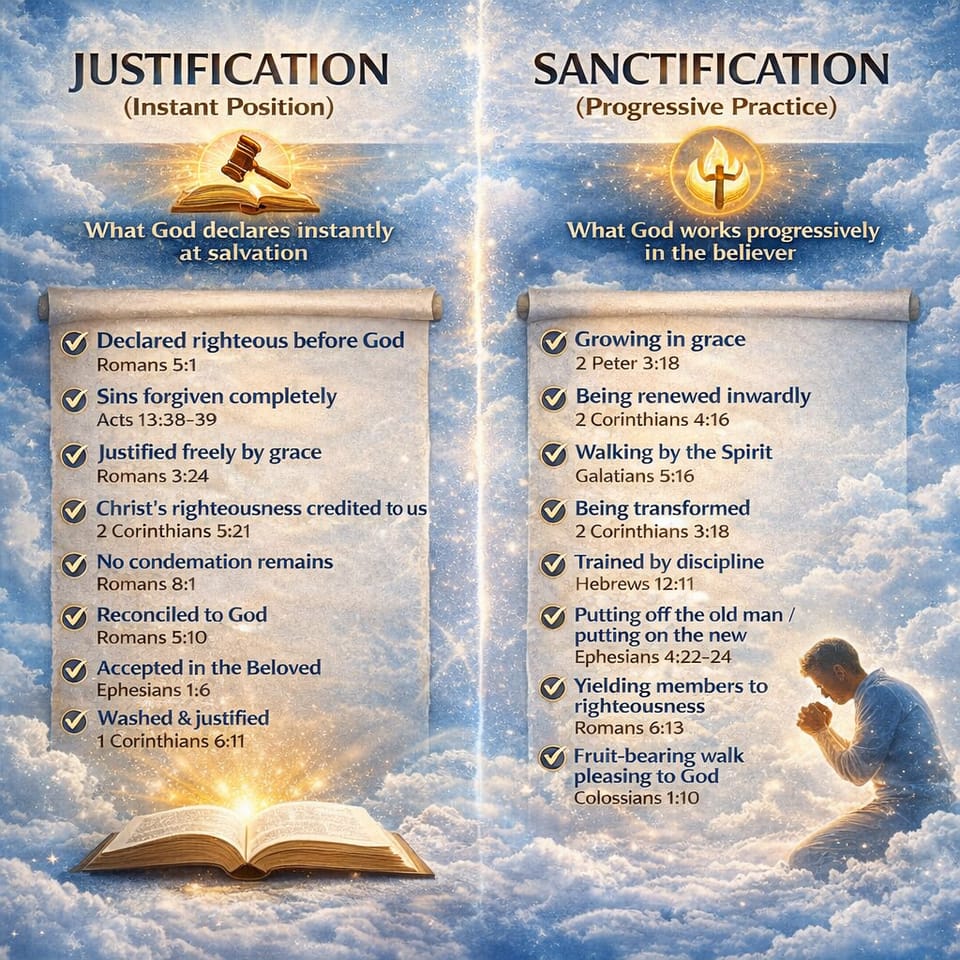
Justification can be seen as an instant position, and sanctification as a progressive practice. Both are gifts of grace. One establishes our standing before God; the other shapes our daily walk with Him.
Understanding this distinction brings assurance, humility, peace, and motivation for holy living.
Part 1: Justification — Our Instant Position Before God
What Is Justification?
Justification is a legal declaration by God that a sinner is righteous, not because of works, but because of faith in Jesus Christ. It is not a process; it occurs at the moment of salvation.
Romans 5:1 (KJV)
“Therefore being justified by faith, we have peace with God through our Lord Jesus Christ:”

To be justified means:
- Our sins are forgiven
- Christ’s righteousness is credited to us
- We are declared righteous in God’s sight
Justification Is Declared, Not Earned
Justification is entirely God’s work. No amount of effort, obedience, or reform can contribute to it.
Romans 3:24 (KJV)
“Being justified freely by his grace through the redemption that is in Christ Jesus:”
The word freely eliminates all boasting. Grace means undeserved favor.
Acts 13:38–39 (KJV)
“Be it known unto you therefore, men and brethren, that through this man is preached unto you the forgiveness of sins:
And by him all that believe are justified from all things, from which ye could not be justified by the law of Moses.”
The law exposes sin; Christ removes it.
Christ’s Righteousness Credited to Us
Justification involves imputation—our sin placed on Christ, and His righteousness placed on us.
2 Corinthians 5:21 (KJV)
“For he hath made him to be sin for us, who knew no sin; that we might be made the righteousness of God in him.”

This is the heart of the gospel. God does not pretend we are righteous; He credits us with Christ’s righteousness.
No Condemnation Remains
Justification permanently changes our standing.
Romans 8:1 (KJV)
“There is therefore now no condemnation to them which are in Christ Jesus…”

Not less condemnation. No condemnation.
Romans 5:10 (KJV)
“For if, when we were enemies, we were reconciled to God by the death of his Son…”
Justification brings reconciliation, peace, and acceptance.
Accepted in the Beloved
Ephesians 1:6 (KJV)
“To the praise of the glory of his grace, wherein he hath made us accepted in the beloved.”
Our acceptance is not based on performance, maturity, or spiritual progress—it is based on Christ alone.
1 Corinthians 6:11 (KJV)
“But ye are washed, but ye are sanctified, but ye are justified in the name of the Lord Jesus…”

Justification is finished. It is settled forever.
Part 2: Sanctification — God’s Progressive Work in the Believer
What Is Sanctification?
Sanctification is the ongoing process by which God transforms the believer’s life to reflect Christ. Unlike justification, sanctification takes time, involves spiritual discipline, and continues throughout our earthly life.
1 Thessalonians 4:3 (KJV)
“For this is the will of God, even your sanctification…”

Sanctification does not make us more saved—it makes us more Christ-like.
Growing in Grace
2 Peter 3:18 (KJV)
“But grow in grace, and in the knowledge of our Lord and Saviour Jesus Christ.”

Growth implies process. There are stages, seasons, struggles, and victories.
2 Corinthians 4:16 (KJV)
“Though our outward man perish, yet the inward man is renewed day by day.”
Sanctification is an inward renewal that shows outward fruit over time.
Walking by the Spirit
Galatians 5:16 (KJV)
“Walk in the Spirit, and ye shall not fulfil the lust of the flesh.”

Justification removes sin’s penalty. Sanctification weakens sin’s power.
Romans 6:13 (KJV)
“Yield yourselves unto God… as instruments of righteousness unto God.”

This yielding is daily, intentional, and Spirit-led.
Being Transformed
2 Corinthians 3:18 (KJV)
“But we all… are changed into the same image from glory to glory…”
Sanctification is progressive transformation, not instant perfection.
Ephesians 4:22–24 (KJV)
“Put off… the old man…
And be renewed in the spirit of your mind;
And put on the new man…”
This is an ongoing practice empowered by grace.
Discipline and Training
Hebrews 12:11 (KJV)
“Now no chastening for the present seemeth to be joyous… nevertheless afterward it yieldeth the peaceable fruit of righteousness…”
God uses discipline not to punish, but to refine.
Colossians 1:10 (KJV)
“That ye might walk worthy of the Lord unto all pleasing, being fruitful in every good work…”

👉 Fruit is evidence of sanctification, not the basis of salvation.
Part 3: Holding Both Truths Together
Justification answers the question:
“How am I made right with God?”
Sanctification answers:
“How does God change me after I am saved?”
| Justification | Sanctification |
|---|---|
| Instant | Progressive |
| Legal standing | Daily practice |
| Declared righteous | Being made holy |
| God’s work alone | God working through us |
| Complete at salvation | Ongoing until glorification |
Confusing these leads to spiritual exhaustion. Understanding them brings freedom and purpose.
Conclusion
Justification gives us peace with God. Sanctification gives us power to live for God. Both are gifts of grace, rooted in Christ, and sustained by the Holy Spirit.
We do not obey to be justified.
We obey because we are justified.
Philippians 1:6 (KJV)
“Being confident of this very thing, that he which hath begun a good work in you will perform it until the day of Jesus Christ.”

God finishes what He starts.